
What is Pixel Pitch?
One of the first specifications customers see when purchasing an LED display is pixel pitch.
P1.2, P1.5, P1.8, P2.5, P3.9, P4.8…
At first glance, these numbers may look simple, but in real LED projects, pixel pitch directly affects:
- Viewing distance
- Visual sharpness
- Screen resolution
- Project budget
- Camera compatibility
- Installation environment
- Customer experience
In many projects, choosing the wrong pixel pitch can easily lead to either:
- unnecessary overspending
or - poor visual performance after installation.
What Pixel Pitch Actually Means
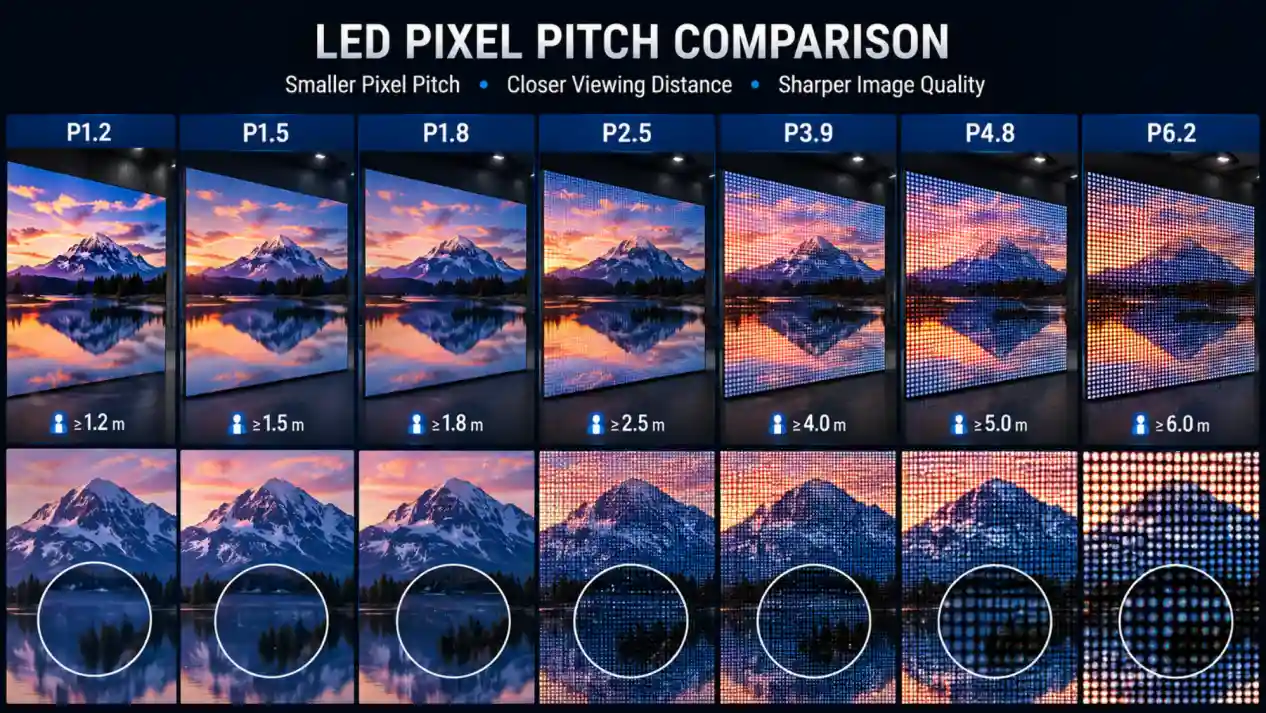
Pixel pitch refers to the distance between two adjacent LED pixels.
The unit is:
millimeters (mm)
For example:
Pixel Pitch | Pixel Distance |
P1.5 | 1.5mm |
P2.5 | 2.5mm |
P3.9 | 3.9mm |
P10 | 10mm |
Smaller pixel pitch means:
- Higher pixel density
- Sharper image quality
- Better close-viewing experience
Larger pixel pitch usually means:
- Lower cost
- Longer viewing distance
- Higher brightness capability
Why Pixel Pitch Is So Important in Real Projects
Many first-time buyers focus only on screen size.
However, experienced LED engineers usually ask these questions first:
- What is the viewing distance?
- Indoor or outdoor?
- Will cameras be used?
- Is this for XR or broadcast?
- Is the audience moving or fixed?
- Is the content text-heavy or video-heavy?
Because the same screen size can require completely different pixel pitches depending on the application.
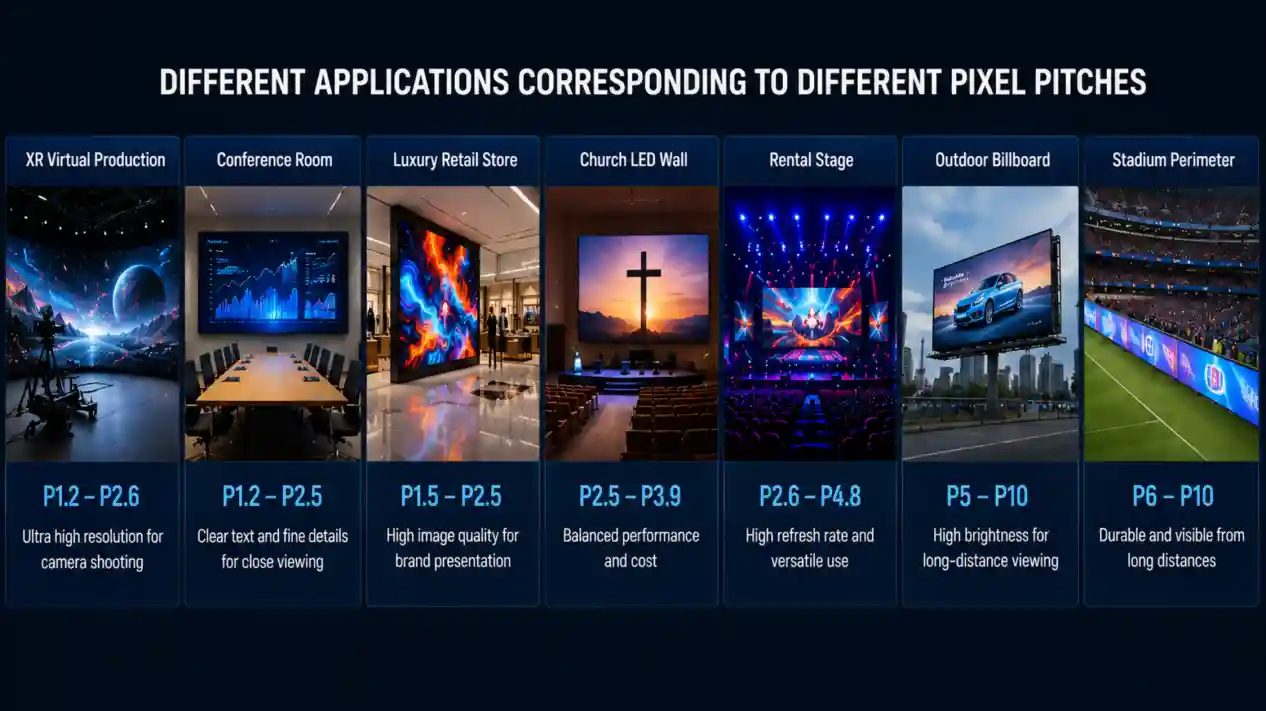
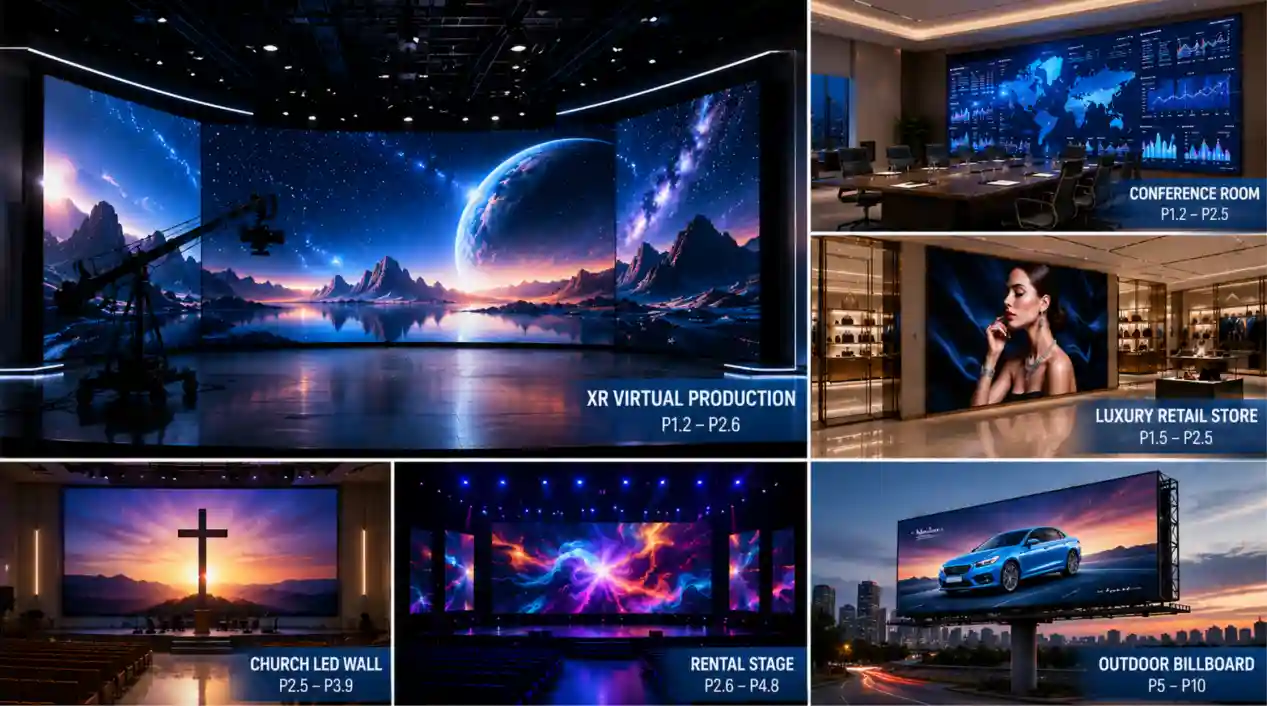
For example:
Application | Typical Pixel Pitch |
XR Virtual Production | P1.2–P2.6 |
Conference Room | P1.2–P2.5 |
Luxury Retail Store | P1.5–P2.5 |
Church LED Wall | P2.5–P3.9 |
Rental Stage | P2.6–P4.8 |
Outdoor Billboard | P5–P10 |
Stadium Perimeter | P6–P10 |
Smaller Pixel Pitch Does Not Always Mean Better
One common misunderstanding in the LED industry is:
“The smaller the pitch, the better the screen.”
This is not always true.
For example:
Using P1.2 in a large outdoor billboard viewed from 80 meters away usually makes little sense.
The audience cannot visually recognize the extra resolution, but the project cost may increase dramatically.
On the other hand, using P4.8 in a luxury retail showroom where customers stand 1-2 meters away may look coarse and reduce premium visual quality.
Real LED engineering is about matching the correct pitch to the actual environment.
Why High-End Projects Usually Use Smaller Pitch
High-end applications usually require:
- Closer viewing distance
- Better visual detail
- Camera compatibility
- Fine text presentation
- Premium appearance
This is especially common in:
- XR studios
- Broadcast environments
- Corporate showrooms
- Retail flagship stores
- Luxury commercial spaces
- Control rooms
In these projects, finer pitch displays create much smoother visual surfaces.
DDW Engineer Notes
Many overseas customers initially request ultra-fine pixel pitch without fully considering viewing distance and budget balance.
In real projects, proper pixel pitch selection should always combine:
- viewing distance
- installation environment
- content type
- camera requirements
- maintenance conditions
- total project cost
The best LED screen is not necessarily the smallest pitch.
It is the pitch that best fits the actual application.