
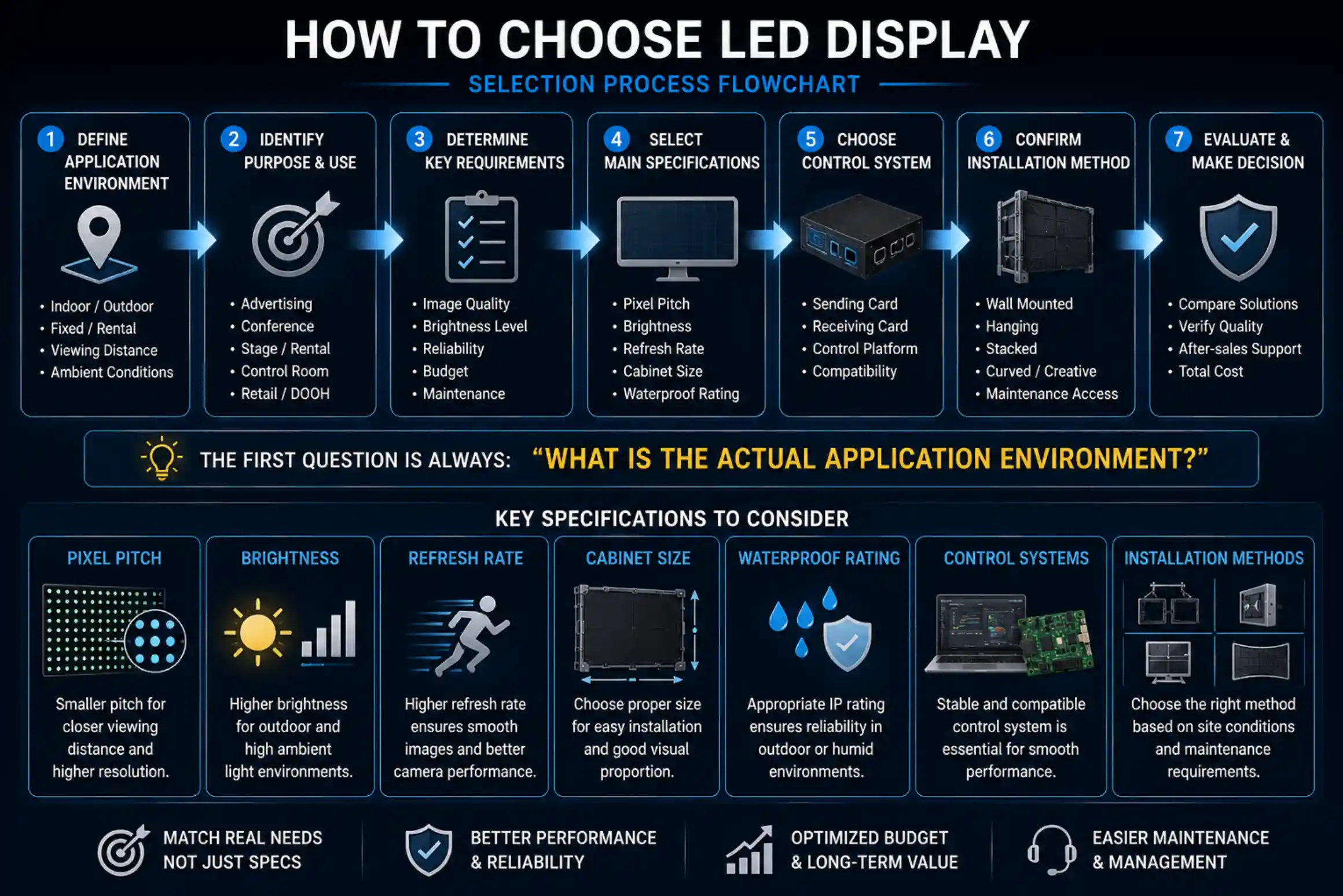
For many first-time buyers, choosing an LED display can feel confusing because there are too many specifications:
- pixel pitch
- brightness
- refresh rate
- cabinet size
- waterproof rating
- control systems
- installation methods
However, experienced LED engineers rarely begin with specifications alone.
The first question is usually:
“What is the actual application environment?”
Why Application Matters More Than Specifications
The same LED product may perform completely differently in different environments.
For example:
Application | Main Priority |
XR Studio | Camera performance |
Church | Viewing comfort |
Outdoor Billboard | Brightness & reliability |
Retail Store | Premium appearance |
Conference Room | Text readability |
Stadium | Long-distance visibility |
Exhibition Booth | Fast installation |
This is why professional LED selection always starts from the real project scenario.
The 5 Most Important Factors
- Viewing Distance
Closer viewing usually requires finer pixel pitch.
- Indoor or Outdoor
Outdoor systems prioritize:
- waterproofing
- brightness
- heat resistance
Indoor systems prioritize:
- image smoothness
- close-viewing comfort
- elegant appearance
- Installation Method
Different installation methods require different cabinet structures:
- wall mounted
- hanging
- curved
- floor support
- transparent facade
- Content Type
Text-heavy applications usually need finer pitch.
Video-heavy projects may allow larger pitch.
- Long-Term Maintenance
Many buyers underestimate future maintenance requirements.
Easy maintenance access often becomes critical after years of operation.
DDW Engineer Notes
Many customers initially compare only specifications and pricing.
However, experienced system integrators usually evaluate:
- environment
- audience behavior
- maintenance conditions
- operating hours
- future scalability
The best LED display is not always the highest specification.
It is the system that best fits the real project.