
Core Understanding
LED displays operate by controlling millions of tiny LEDs to create dynamic images and videos in real time.
Each LED pixel emits different levels of red, green, and blue light to generate full-color visuals.
Basic Working Principle
The process generally includes:
- Video signal input
- Signal processing
- Data transmission
- Receiving card decoding
- LED module display
RGB Color Mixing
Each pixel contains:
- Red LED
- Green LED
- Blue LED
By adjusting brightness levels of RGB LEDs, the display can reproduce millions of colors.
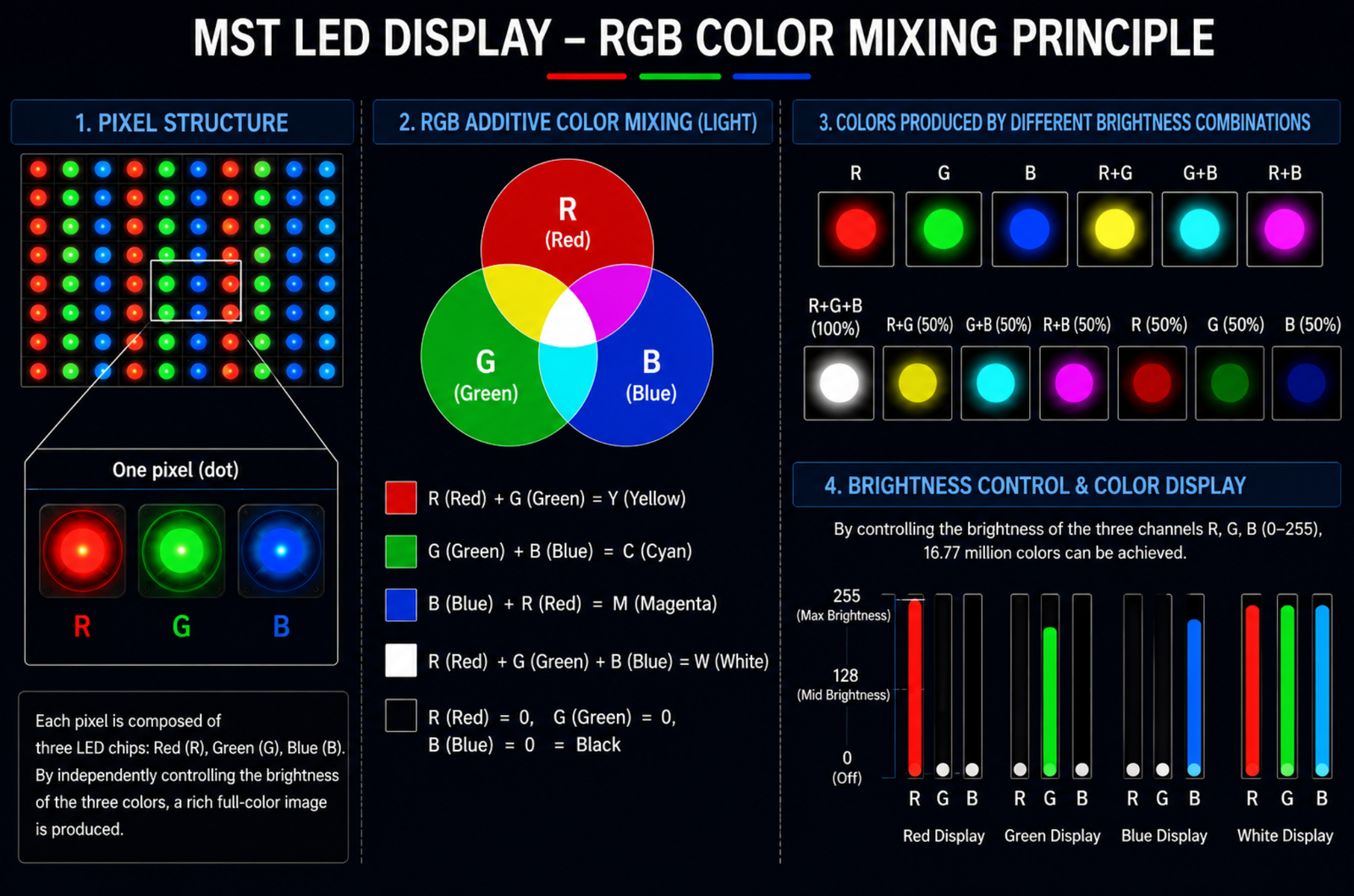
Image Refresh Process
LED displays continuously refresh image frames at high speed.
High refresh rates provide:
- Smooth motion
- Flicker-free visuals
- Better camera performance
Typical refresh rates:
- 1920Hz
- 3840Hz
- 7680Hz
Signal Transmission
The signal path:
Computer → Video Processor → Sending Card → Receiving Card → LED Module

Synchronizing vs Asynchronous Systems
Synchronizing System
Real-time signal transmission.
Used for:
- Live events
- XR stages
- Broadcast
Asynchronous System
Content stored locally.
Used for:
- Advertising screens
- Digital signage
DDW Technical Insight
LED displays combine advanced electronics, image processing, and digital control systems to deliver seamless large-scale visuals across countless professional applications.