
Indoor Pixel Pitch Guide
Indoor LED projects are usually where pixel pitch selection becomes the most sensitive.
Unlike outdoor advertising screens, indoor environments often involve:
- closer viewing distance
- finer content details
- text-heavy presentations
- camera shooting
- luxury commercial aesthetics
This is why indoor LED projects usually require much more careful pitch planning.
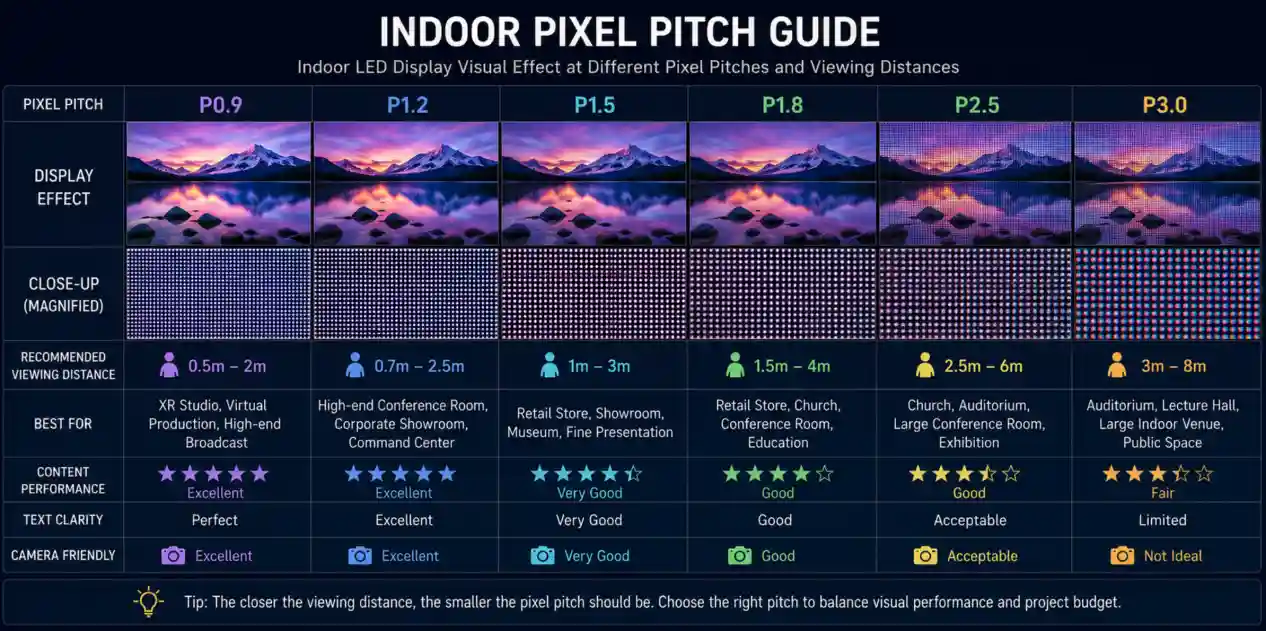
Why Indoor Projects Usually Need Smaller Pixel Pitch
In indoor environments, viewers often stand very close to the screen.
Examples:
- conference rooms
- corporate lobbies
- retail flagship stores
- XR studios
- broadcast control rooms
- museums
- exhibition halls
If pixel pitch is too large, viewers may clearly notice:
- pixel structure
- rough image edges
- poor text sharpness
- uneven visual surfaces
This becomes especially obvious in premium commercial environments.
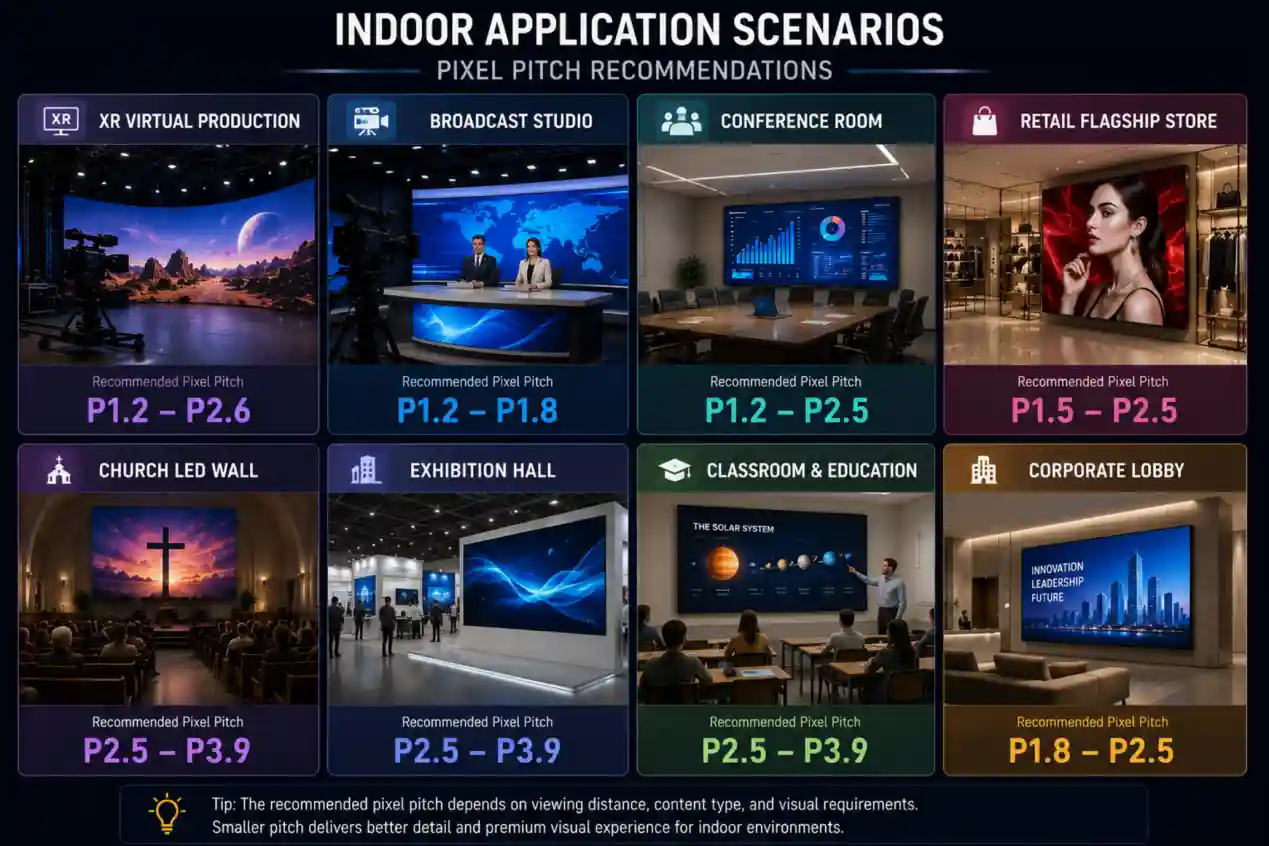
Typical Indoor Pixel Pitch Recommendations
Indoor Application | Recommended Pixel Pitch |
XR Virtual Production | P1.2–P2.6 |
Broadcast Studio | P1.2–P1.8 |
Conference Room | P1.2–P2.5 |
Retail Flagship Store | P1.5–P2.5 |
Church LED Wall | P2.5–P3.9 |
Exhibition Hall | P2.5–P3.9 |
Classroom & Education | P2.5–P3.9 |
Corporate Lobby | P1.8–P2.5 |
Why Retail Projects Often Use Smaller Pitch
Luxury retail environments usually prioritize:
- premium visual quality
- smooth image surface
- close viewing comfort
- strong brand presentation
Customers in shopping malls often stand only 1-3 meters away from the display.
This is why many high-end retail projects prefer:
- 5
- 8
- 0
Even if larger pitch could technically still work.
Conference Rooms Usually Need Balance
Many conference room projects do not actually require ultra-fine pitch.
The key is balancing:
- viewing distance
- budget
- text readability
- maintenance convenience
In many medium-sized meeting rooms:
P2.5 already provides very good visual performance.
However, for premium boardrooms or executive briefing centers, finer pitch often improves overall project appearance significantly.
DDW Engineer Notes
Many indoor projects fail not because the screen is low quality, but because the selected pitch does not match actual viewing behavior.
For example:
In exhibition booths, customers often move much closer to the display than originally expected.
In corporate showrooms, fine text and close-up product videos may require finer pitch than standard conference applications.
Indoor pitch selection should always consider how people truly interact with the screen.